
Decision piece
Madrid historic center without tourist traps
One interior decision, several outdoor stops and nothing you have to insist on
Updated: July 2026
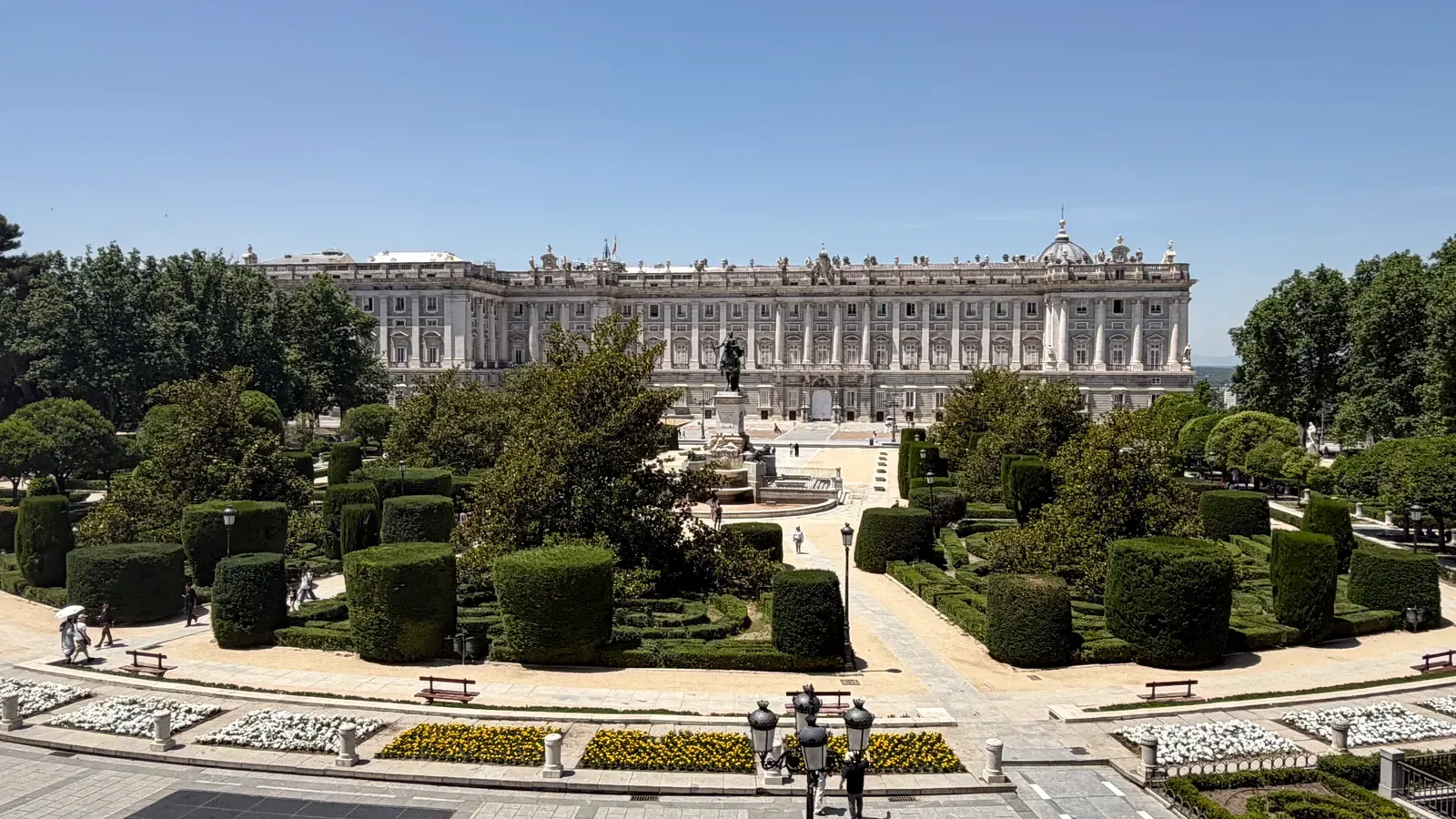
The historic center of Madrid looks easy because everything is close — and that’s where it traps you. You walk into interiors by inertia, queue where it doesn’t pay off and start confusing famous with essential. You don’t need to enter every landmark to read this area. One well-chosen interior visit and several places read from the street are usually a better first visit than ticking off doors. If you only enter one interior, you’re not skipping the center — you’re reading it right.
Quick facts
- Area: Palacio Real, Plaza de Oriente, Plaza de la Villa, Plaza Mayor and Puerta del Sol
- Main decision: enter the Palacio Real or read most of the area from outside
- Where to begin: Palacio Real, whether you enter or not
- Interior visit: Palacio Real only
- Changing of the Guard: Wednesdays and Saturdays, outdoors and free; summer hours differ, and the larger Solemn version usually takes place on the first Wednesday of the month
- Booking: online booking is recommended for the Palacio Real; check the official site before going
- English-friendly: the Palacio Real has English signage, English audio guides and guided tours in English
Plan your visit
If you’re entering the Palacio Real
Put it first in the day. It’s the visit that conditions everything else: entry time, queues and energy. Leave it for later and the rest of the morning drifts.
If you’re not entering the Palacio Real
Read the area from Plaza de Oriente, walk past Almudena Cathedral and continue through Plaza de la Villa, Plaza Mayor and Puerta del Sol. Skipping a ticket office isn’t a poor visit here. Often it’s the better one.
If your visit lands on a Wednesday or Saturday
The standard Changing of the Guard takes place in the morning at the Palacio Real. If it matters to you, check the official schedule before fixing the rest of the morning. Treat it as a good extra if the timing works, not as something the whole day has to depend on.
Suggested direction
This isn’t a fixed route. Use it to orient yourself before deciding where to stop.
Suggested line: Palacio Real → Plaza de Oriente → Almudena Cathedral → Plaza de la Villa → Plaza Mayor → Puerta del Sol. Calle Mayor connects most of it.
The one interior decision
Palacio Real
The Palacio Real is the only interior in this area that earns the right to shape your day — and the only one where deciding to enter or not really matters.
The current building was raised over the old Alcázar, destroyed by fire in 1734. Felipe V ordered a new palace on the same site, and Carlos III was the first monarch to live in it. That detail explains the layout of the whole center: power sat here, and the historic core organized itself around that presence for centuries.
It’s still the official royal residence, though the royal family doesn’t actually live here — they live in the Palacio de la Zarzuela, outside the city. The Palacio Real is used for state ceremonies, which is the source of most of its friction: opening hours and access can shift.
Worth knowing
Entering only makes sense if you put it first in your day. From outside — especially from the Jardines de la Plaza de Oriente and the Plaza de la Armería next to Almudena Cathedral — the monumental scale is already clear. The mistake isn’t skipping the interior. The mistake is letting a queue, a bad time or an official closure derail your whole morning.
The standard Changing of the Guard takes place every Wednesday and Saturday at the Puerta del Príncipe on Calle Bailén, 11:00-14:00 (10:00-12:00 in July and August). It’s visible from the street, free, no ticket needed. The larger Solemn Changing of the Guard takes place on the first Wednesday of most months. Both can be canceled by weather or official events; check the official schedule the day before.
Before you enter
- Closures: no fixed weekly closure, but the Palacio Real can shut for state ceremonies or official events on short notice. Check the official site the day before.
- Hours: opening at 10:00 daily, last entry one hour before closing (18:00 October-March, 19:00 April-September; Sundays close at 16:00 year-round).
- Booking: online booking recommended, especially in high season.
- Tickets: standard admission €18, with an optional €5 audio guide.
- Free entry: weekday afternoons for EU and Ibero-American citizens, at the box office only. If you’re traveling from the US, UK, Canada or Australia, plan to buy a ticket.
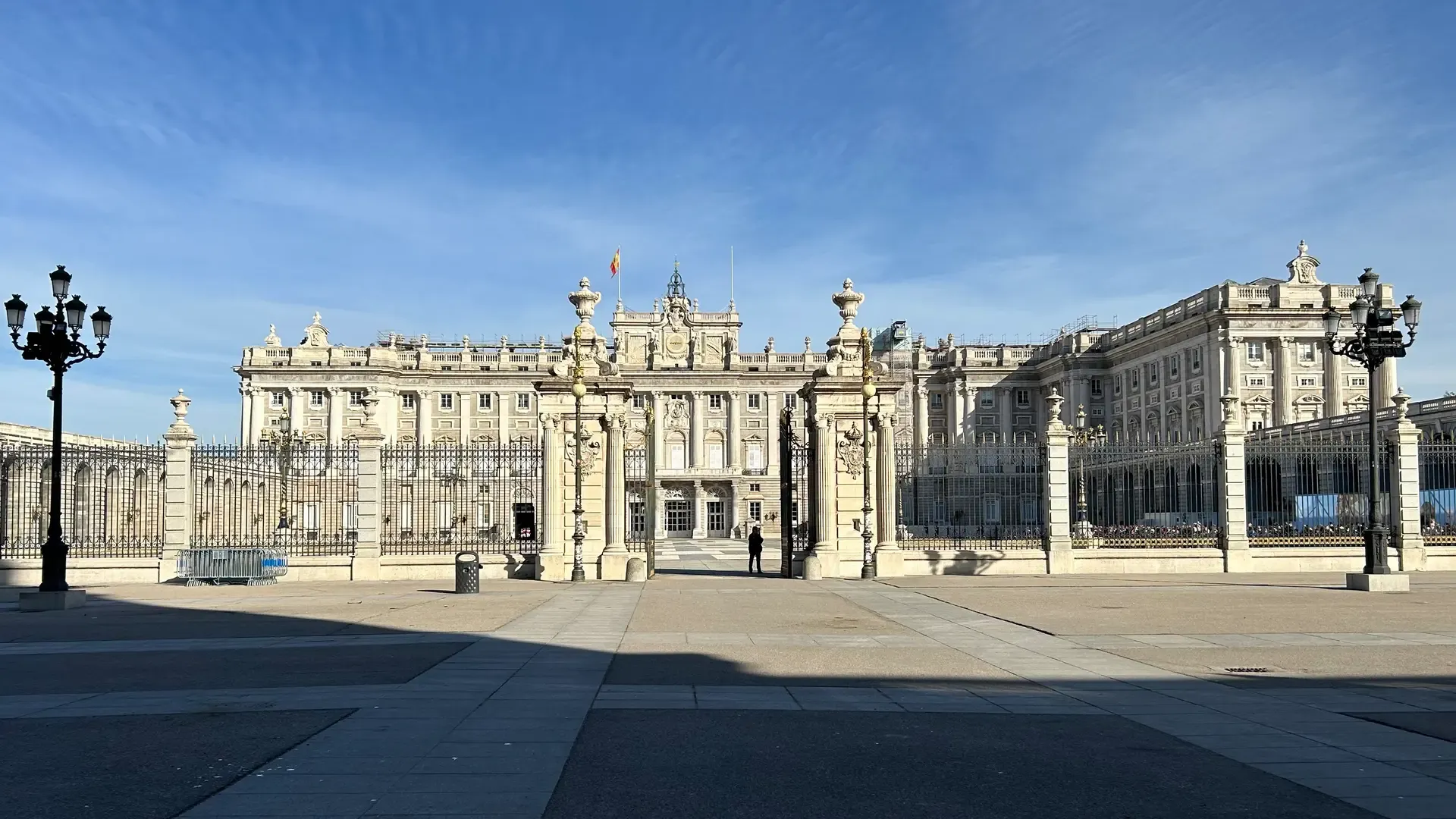
Palacio Real from the Plaza de la Armería — where you stand to read it from outside.
Worth stopping for
Plaza de Oriente
Plaza de Oriente is the right place to read the Palacio Real before deciding whether to enter. The volume, the relation to the Teatro Real, the scale of this corner of the center — all of it makes sense from here without crossing a ticket office.
The plaza was opened in the early nineteenth century by José Bonaparte, who wanted to clear the surroundings of the Palacio Real and the Teatro Real. It isn’t a park placed at random: it’s an urban operation designed so power could be seen more clearly, flanked by statues of former Spanish kings.
At its center stands the equestrian statue of Felipe IV, cast by Pietro Tacca in 1640. Tradition credits Galileo with the calculations that let the horse stay balanced on its hind legs. A small detail, but it changes how you look at the plaza: you’re looking at a garden, but also at engineering and a court putting itself on display.
Worth knowing: if you’re not entering the Palacio Real, this stop carries more weight. It’s the best place to read the whole monumental ensemble without turning the visit into one more interior.
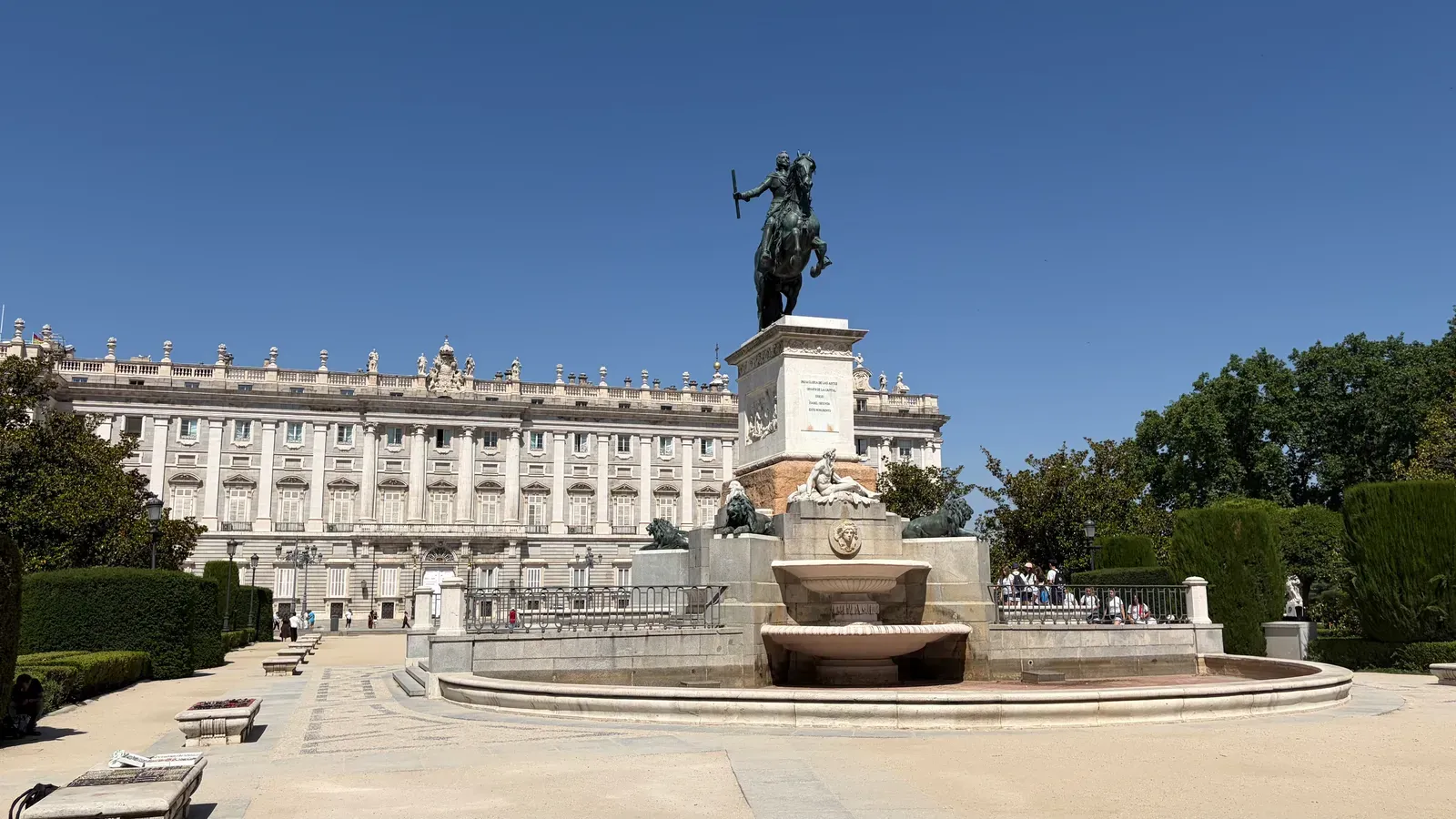
The equestrian statue of Felipe IV with the Palacio Real behind.
Plaza de la Villa
Plaza de la Villa is one of the few stops in the center that still feels old without performing it. It doesn’t compete on size or easy photos, but it reads medieval Madrid more cleanly than several far more famous places.
The value is in what you see standing still: three buildings, three centuries. The Casa y Torre de los Lujanes, from the fifteenth century, is one of the oldest civil buildings preserved in Madrid; tradition says Francis I of France was held — or lodged — there after the Battle of Pavia in 1525. The Casa de Cisneros, from the sixteenth century, adds the Plateresque layer. The Casa de la Villa, from the seventeenth, was the seat of Madrid’s city government for centuries.
Arrive with that in mind and the plaza stops being “a small pretty square” and becomes one of the few spots where you can read medieval, Renaissance and Baroque Madrid in a single glance.
Worth knowing: don’t inflate it. Its strength is the scale, the façades and the change of tone from Plaza Mayor or Puerta del Sol.
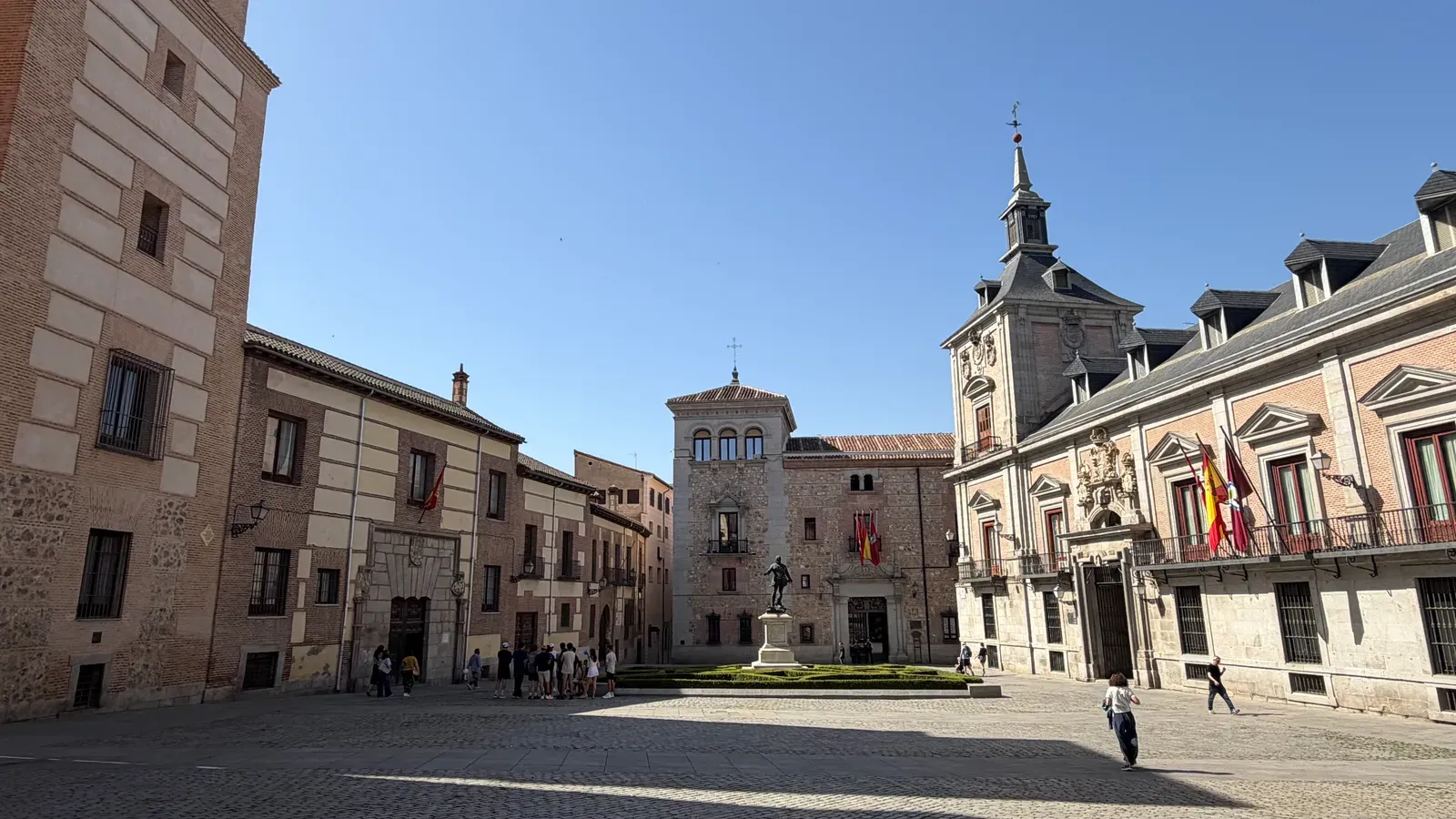
Plaza de la Villa — three buildings from three centuries in a single glance.
Plaza Mayor
Plaza Mayor earns its place on a first visit. Not because it hides a secret, but because it summarizes Madrid as a capital better than any other single space: a closed, organized plaza built to hold market, power and public life at once.
Before it was Plaza Mayor it was Plaza del Arrabal, a market outside the first medieval walls. Felipe III and Juan Gómez de Mora turned it into the city’s representative square, finished in 1620. What you see today isn’t exactly that one: several fires, especially the one in 1790, forced the reconstruction that gave it its current uniform profile.
It was a stage in the literal sense — royal proclamations, festivals, markets, bullfights and also autos-da-fé. That’s why it’s worth more than a pretty-square glance: it was one of the places where Madrid put itself on display.
Worth knowing: walk in, look properly, cross under the arcades and leave without guilt. Its value is in understanding it, not in lingering. Right next to it sits the Mercado de San Miguel. It looks like a neighborhood market but works as a high-priced tasting hall for tourists. Walk through it for the iron architecture if you like, but if you want to eat well in Madrid, eat elsewhere.
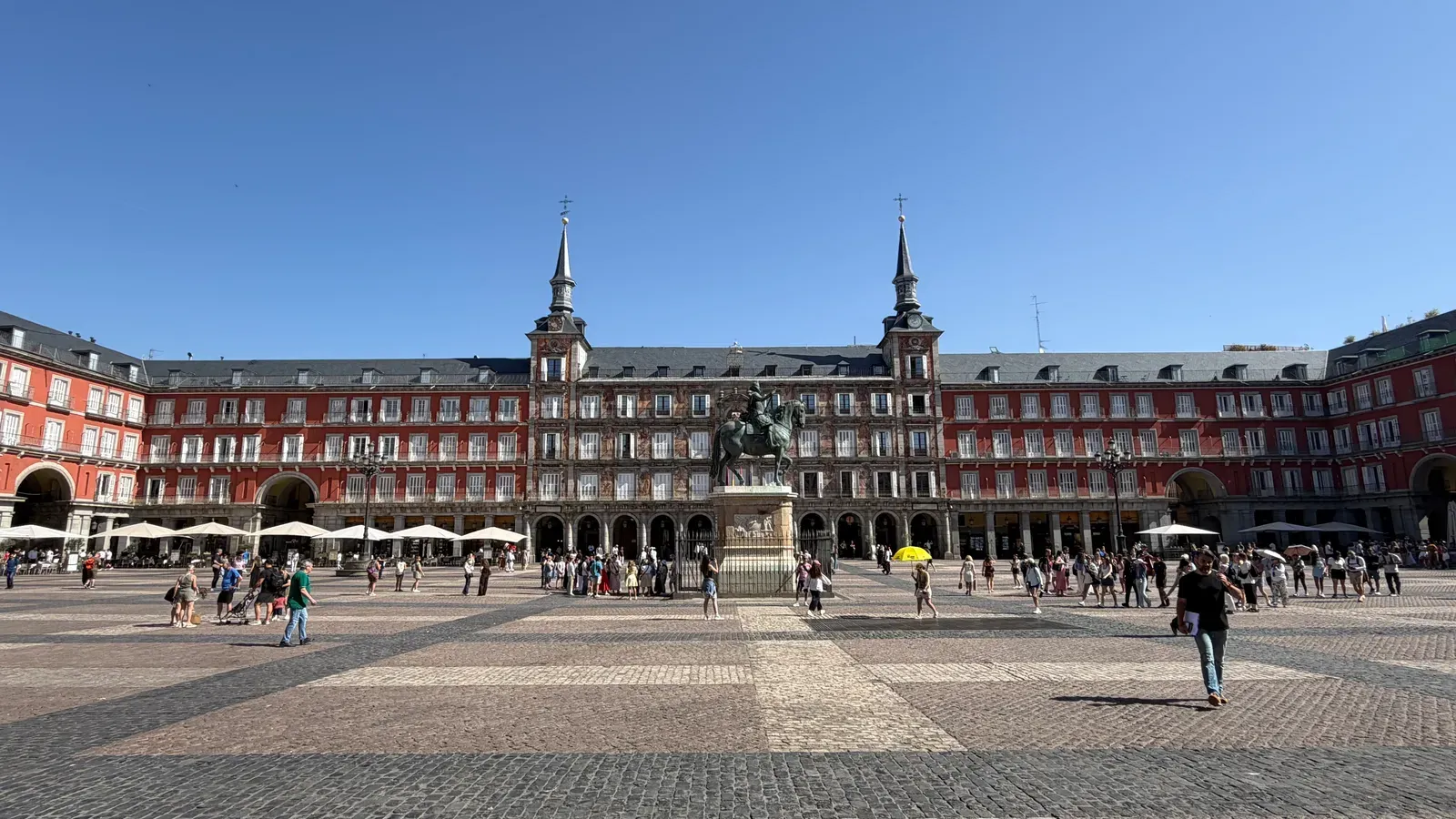
Plaza Mayor — the closed square where Madrid put itself on display.
Read from outside, or keep moving
Almudena Cathedral
The Almudena is in this guide for context, not because it’s the great historic cathedral many first-time visitors imagine. It sits next to the Palacio Real, completes the monumental ensemble and is dedicated to the Virgen de la Almudena, the city’s patron.
Madrid became the capital in 1561 but didn’t have its own diocese for centuries — it depended on Toledo. The Almudena arrived late to fix that. The first stone was laid in 1883 and it wasn’t consecrated until 1993, by John Paul II.
That explains what’s inside: it lacks the unity and age of cathedrals like Toledo, León or Burgos, and its more modern aesthetic divides opinion. From outside it helps you read the Palacio Real’s axis; inside, it depends on what you’re looking for.
Worth knowing: seeing it from outside is usually enough. The interior, the crypt, the museum and the dome are separate decisions; if you want more than the exterior, check hours, access and price on the official site.
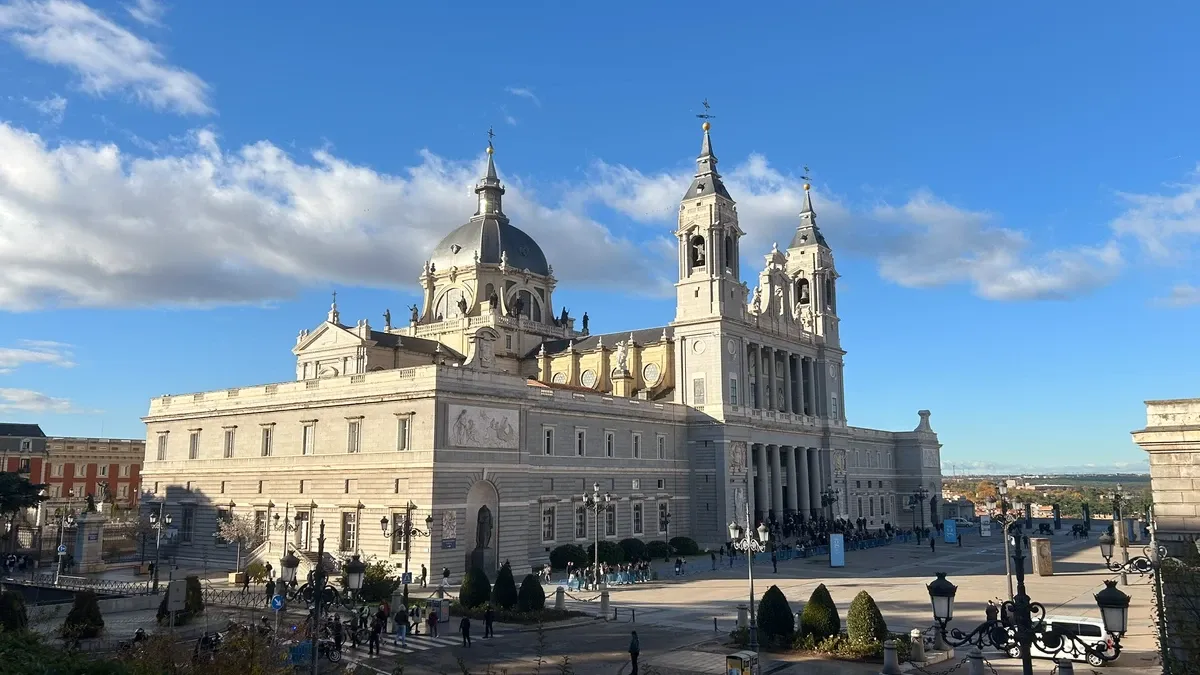
Almudena Cathedral — enough from the outside for most first visits.
Puerta del Sol
Puerta del Sol matters because it organizes Madrid, not because it asks you to stay. It’s not a place to linger, but it’s one of the most symbolic squares in the city: Kilómetro Cero is here, along with the clock of the Real Casa de Correos and the statue of the Oso y el Madroño.
Kilómetro Cero, in front of the Real Casa de Correos, marks the radial center of Spain’s road network. Its clock anchors Spain’s televised New Year’s Eve countdown. The Oso y el Madroño represents the city’s coat of arms and works as a classic meeting point.
That’s the real role of Sol: more useful as a place to orient yourself and connect to other areas — Plaza Mayor, Gran Vía, Preciados, Alcalá, Arenal — than as a long stop.
Worth knowing: lots of foot traffic, lots of noise, no pause. Spend a few minutes, locate the symbols and move on.
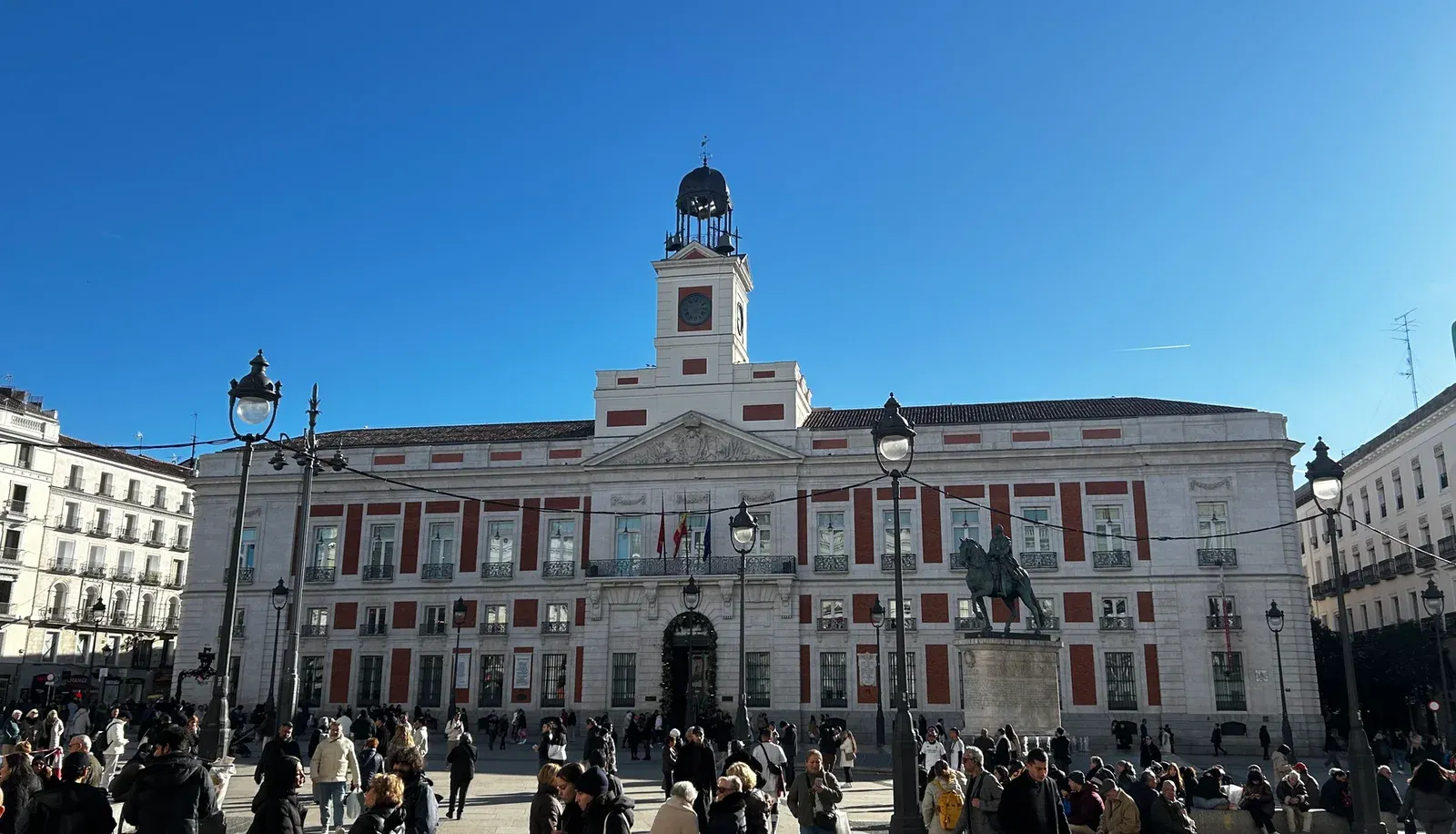
Real Casa de Correos on Puerta del Sol — the clock, the crowd, the crossroads.
My verdict
The historic center of Madrid is worth your time, but not as a chain of interiors and not as a checklist of famous names. The real trap isn’t a specific place. It’s giving everything the same weight.
I’d recommend the area for any first visit: there’s no Madrid without it. I wouldn’t try to enter everything that looks important. What makes it work is choosing one strong interior — the Palacio Real — and reading the rest from the street with patience. If the Changing of the Guard fits your timing, good. If not, the area still works.
For any interior beyond the Palacio Real, plan separately: bookings, hours and languages vary. That’s not a decision for a first walk through this area.
Before you go
- Wear real walking shoes. The area is compact but pavement-heavy — you’ll spend more time on foot than the map suggests.
- Weekends get crowded fast. Sol and Plaza Mayor fill from late morning onwards. Pick a weekday if you can.
- Large bags at the Palacio Real: current access guidance discourages big backpacks, suitcases and bulky packages during improvement works. If you’re entering, travel light and check the official site before going.
- Almudena: seeing it from outside, entering the church, visiting the crypt or going up to the dome are four different decisions. If you want more than the exterior, check hours, access and price.
Continue your day
If you want this area as a step-by-step morning route, start with How to spend your first morning in Madrid.
If you’re building the rest of the day, pair it with How to spend your first afternoon in Madrid or How to spend your first evening in Madrid.
If you want to follow it with calm culture, it pairs well with Retiro and Prado: a calm first-visit day.